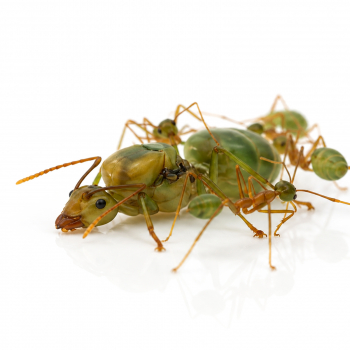
While doing more research i have found more proof to suppoert this theory .

COOPERATION BETWEEN DEALATE QUEENS DURING
COLONY FOUNDATION IN THE GREEN TREE ANT,
OECOPHYLLA SMARAGDZNA
Colony reproduction in ants typically occurs through the foundation
of a new nest by a single mated queen (haplometrosis), but
sometimes involves several cooperating queens (pleometrosis).
Pleometrosis enables successful colony foundation under adverse
conditions (reviewed by Rissing and Pollock 1988), but it is not
necessarily followed by polygyny once the colony has become
established.
There exist two species of Oecophylla, both of which are conspicuous
arboreal ants who weave living leaves into nests using larval
silk. Although mature colonies can be extremely populous (half a
million workers) and can be made up of hundreds of nests in many
adjoining trees (Holldobler and Wilson 1977, Holldobler 1983), they
are strictly monogynous (e.g. Holldobler and Wilson 1983a,
Greenslade 1971). Early observations on colony reproduction in the
Asio-Australian species 0. smaragdina by Dodd (1902) and
Maxwell-Lefroy and Howlett (1909:233) have led to the assumption
that a new colony is established by a single queen. However, various
observations on the African species 0. longinoda suggest that it is
pleometrotic. Richards (1969) observed a group of 11 dealate
queens together with many eggs and larvae on a window ledge, and
Ledoux (1950) failed to collect single foundresses with brood. Here
we document for the first time pleometrosis in 0. smaragdina, and
this behavior is discussed in the context of the monogynous state of
established colonies.
Y3chool of Biological Science, University of New South Wales, PO Box 1, Kensington
N.S.W. 2033, Australia
'Division of Wildlife and Ecology, CSIRO Tropical Ecosystems Research Centre,
PMB 44, Winnellie N.T. 0821, Australia
Manuscript received by the editor December 8, 1988.
Pzirfif MMW (1989). hup //psyche rnlclub orgUmCrM1! html
40 Psyche pol. %
19891 Peeters & Andersen - Oecophylla 41
Three aggregations of dealate queens were collected in March
1987 from two locations in the coastal region of the Northern Territory,
Australia: (i) suburban Darwin (colony QT-1, comprising at
least 19 queens, plus eggs and larvae; colony QT-2, comprising 6
queens, plus eggs and larvae); (ii) eucalypt woodland at Ubirr,
Kakadu National Park (colony QR-1, comprising 12 queens, 100
eggs, 1 17 larvae and 1 pupa). No further data are available on QT-1.
Colony QT-2 was completely enclosed inside a bent leaf sown
together with silk, and occurred in an isolated shrub at a height of
1.5 m. Seven days after collection, two minor workers appeared
through a hole in the silk wall. In contrast, the queens of colony
QR-1 were on the exposed surface of a leaf, crowded together over
the brood (Fig. 1). When another leaf was placed close to the original
one, the queens soon began to weave, and after three days closed
walls of silk had been spun between the leaves. This nest remained
sealed off until three weeks later, when several minor workers
became active outside the nest. Major workers were never produced.
Colony QR-1 was taken back to Sydney for observations, and
new leaf nests were built in small Ficus trees in the laboratory. The
ants were fed on sugar water, small cockroaches, and wingless Drosophila.
Nests were abandoned whenever the bound up leaves withered,
so that several nest emigrations occurred in the laboratory.
One of these began when over 40 workers first grouped at the new
nest site, many of them holding leaves together. Weaving only
started 2 hours later after several larvae of an appropriate age (silk is
only produced by larvae at the beginning of the final instar; Ho11-
dobler and Wilson 1983b) had been carried from the old nest. Four
hours later some walls of silk had been spun, and although construction
was not finished, eggs and small larvae were being carried
across. The 10 surviving queens then walked across to the new nest
over the next 19 hours. Each queen walked singly along the
branches, apparently following a recruitment trail as their antennae
were held forward, touching the substrate. They often stopped, but
contact with the many workers walking in both directions along the
same trail seemed to induce them to continue. The workers often
remained near a queen whenever they encountered one. On a few
occasions, single workers led queens out of the old nest by walking
backwards and holding the queen's mandibles or the base of one
42 Psyche [vo~9.6
antenna. As the queens were walking between nests, we noted that
three of them were injured; each had parts of antennae and/or
several limbs missing. One of these disappeared from the nest after a
few days. However, direct aggression either among queens or
between queens and minor workers was never observed. The minor
workers frequently regurgitated to the queens, and licked their gasters,
as described in Holldobler and Wilson (1983a).
Males were never produced in the laboratory, indicating that all
dealate queens were probably mated. Dissection of the spermathecae
of nine queens confirmed this.
Several mated queens cooperate to establish new colonies in 0.
smragdina, although only a single queen is found in established
colonies. Single dealate queens with brood have been collected
(Dodd 1902; Maxwell-Lefroy and Howlett 1909, C. Lokkers pers.
comm.; Vanderplank 1960 for 0. longinodu), but it has never been
established whether such behavior led to successful colony foundation.
Ledoux (1950) reported that single dealate queens of 0. longinoda
could construct small sealed nests with their larvae in the
laboratory, but he never found them in the field, and speculated that
natural conditions were too hazardous for them to be successful.
The general advantages of pleometrosis include a faster increase
in the number of workers in a colony, thus producing a foraging
workforce more rapidly. This is important, because dealate queens
do not forage and thus feed the first brood on their metabolized
wing muscles and fat reserves. Until the workers start to bring in
food from outside the nest, colony growth is strictly constrained.
There are additional benefits of pleometrosis that are specific to
Oecophylla. During the initial period, when a nest cannot yet be
built because the first generation of larvae are too young to produce
silk, the physical presence of several large queens serves as an effective
shelter for the brood lying on the leaf. Later in the genesis of a
colony, the construction of a leaf nest is clearly essential. Larvae and
naked pupae require stable microclimatic conditions for their development,
and one advantage of a leaf nest woven with silk is that the
marked daily fluctuations in humidity and temperature are prevented
(Ledoux 1950). The nests also provide shelter against rain
and wind, and possibly various insect enemies.
19891 Peelers & Andersen - Oecophylla 43
Cooperation between foundresses enables the quick construction
of a leaf nest. Whereas a single queen is restricted to weave leaves
that already overlap or are contiguous, the occurrence of several
queens means that leaves can be bent and positioned into place
through a separation of roles. Moreover, many queens initially
mean more larvae, so that more silk is available and larger walls can
be spun. Thus the initial nest can be bigger and better constructed,
which delays the need for expansion and emigration.

 . So i looked this topic up more on the web and it appeares really common in this species . The web page info is below .