ID needed for ant in South Carolina USA

ID needed for ant in South Carolina USA

Beitragvon CapitalO » 31. Okt 2007 22:49

This is my first post on this forum, so I'll start by saying: this site is a wealth of information, very nice! :)

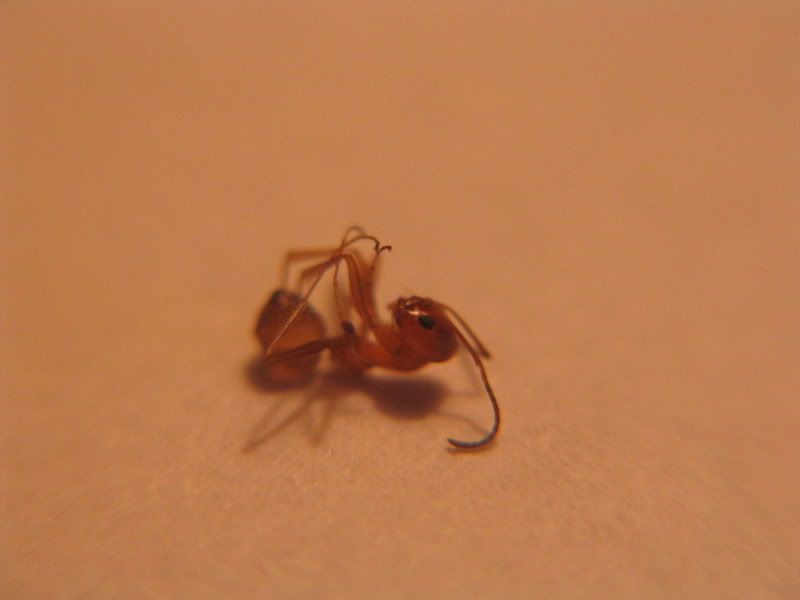
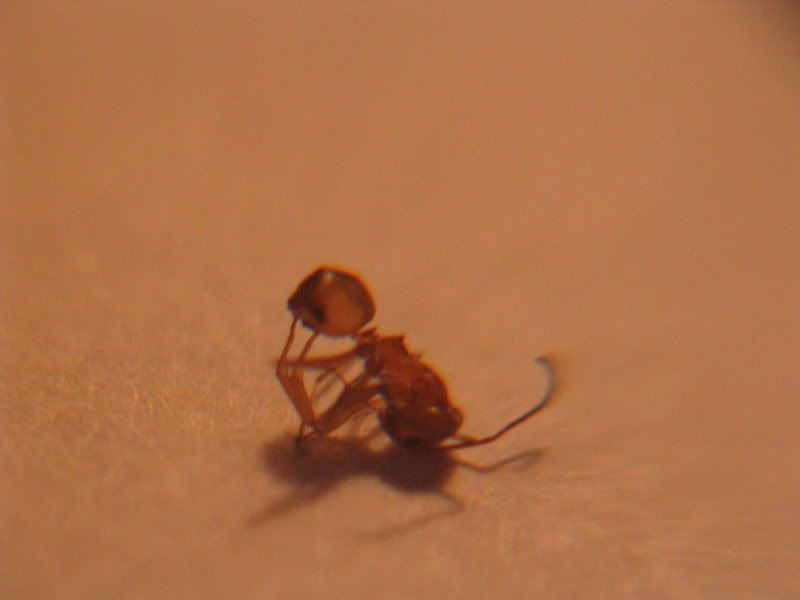
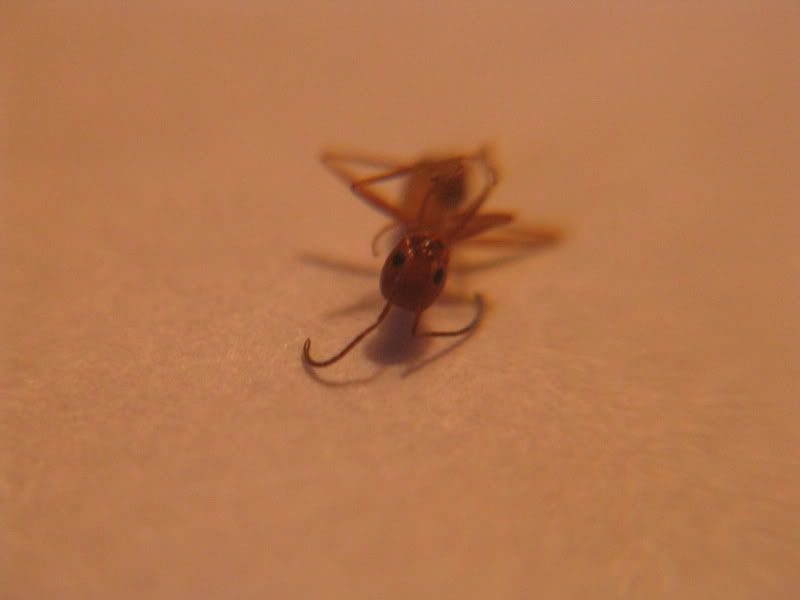
As the subject indicates, I capture a worker from a colony living in my backyard (South Carolina) and I'd like some help to ID it. From the research Ive done, I have a suspicion that this could be Linepithema humile, the argentine ant, although it doesn't really fit the behavior pattern as this species is not aggressive at all. Anyway, I'm having a tough time trying to ID since I'm very new to this hobby. I attached some pictures, but the quality could be better; I have a pretty low end camera and the ant is only about 2mm long.
Bild


Bild


Bild


These ant's seem to forage somewhat independently in small groups, and they are constantly active. They were transferring larvae from one nest to another today as I was watching them. All of the ants Ive seen seem to be about 2mm long workers. Any help is appreciated!
Benutzeravatar
CapitalO
member
member
 
Beiträge: 42
Alter: 40
Registriert: 31. Okt 2007 22:09
Wohnort: South Carolina
Land: United States (us)
Hat sich bedankt: 0 Danke
Danke bekommen: 0 Danke


Werbeanzeige: Aluminium stretch grid ultrafine Mw 2mm - 10cm x 20cm


Beitragvon Philsen » 1. Nov 2007 00:09

Hi,

these ants aren´t Linepithema humile. But Im not too sure...
The color is untypical for Linepithema humile. In my opinion
they might be Monomorium pharaonis. But Im also not sure.
We will see what ohter say...
Benutzeravatar
Philsen
member
member
 
Beiträge: 276
Alter: 36
Registriert: 8. Dez 2006 00:26
Wohnort: Dresden
Land: Germany (de)
Hat sich bedankt: 0 Danke
Danke bekommen: 0 Danke

Beitragvon tail__ » 1. Nov 2007 09:03

All dead ants look so similar :| Maybe find a living one?
tail__
member
member
 
Beiträge: 269
Alter: 45
Registriert: 8. Sep 2007 08:39
Wohnort: Krakow
Land: Poland (pl)
Hat sich bedankt: 0 Danke
Danke bekommen: 0 Danke

Beitragvon CapitalO » 1. Nov 2007 17:56

Thanks for the feedback guys :)

Philsen- I think your right, I doubt these ants are Linepithema humile as well. Although, I don't think they could be Monomorium pharaonis either; as far as I can tell, the ants in question have one node and the pharaonis have two nodes. They do look quite similar in size and coloration though.

tail- These ants are very small, about 2mm, and very fast. Theres no way I could get a decent picture of a live one with the camera I'm using.

I did a bit more research, I think this is a species of Dorymyrmex. Possibly Dorymyrmex bureni; the species is common here in SC and the ants in question fit the profile quite well. They have a single node and a pyramid shaped peak on their thorax, the first picture I posted shows these same features.
Benutzeravatar
CapitalO
member
member
 
Beiträge: 42
Alter: 40
Registriert: 31. Okt 2007 22:09
Wohnort: South Carolina
Land: United States (us)
Hat sich bedankt: 0 Danke
Danke bekommen: 0 Danke

Beitragvon Sphecomyrmex » 2. Nov 2007 14:50

Hello CapitalO,

I think it's a Dorymyrmex specie too. Linepithema humile have mandible longer than this, and Monomorium, like other Myrmicinae species, have two nodes, you said. Then, Linepithema humile have a propodeum curved, while Dorymyrmex have a propodeum convex (the pyramid shaped peak on thorax), like the ant in photos. But Dorymyrmex have scapes shorter than this... I'm not too sure. How long maxillary palpi?
Benutzeravatar
Sphecomyrmex
member
member
 
Beiträge: 391
Alter: 31
Registriert: 1. Okt 2007 14:20
Wohnort: Firenze - Sesto Fiorentino
Land: Italy (it)
Hat sich bedankt: 0 Danke
Danke bekommen: 0 Danke

Beitragvon JimmyVe » 3. Nov 2007 18:18

Hi CapitalO and welcome,

Nice to see you are interested in keeping ants. It a fun hobby. ;)
Can't help you with the species you are looking for. But if it is possible try to get some better pictures.
JimmyVe
member
member
 
Beiträge: 5369
Alter: 45
Registriert: 12. Dez 2005 17:28
Wohnort: Geel
Land: Belgium (be)
Hat sich bedankt: 0 Danke
Danke bekommen: 1 Danke

Beitragvon CapitalO » 5. Nov 2007 01:22

Specomyrmex- I'm uncertain what the maxillary palpi are; but the scapes, as you said, are very long. All of their appendages seem quite long.

JimmyVe- I'll do my best to get some better pictures :)

On a side note, I went hiking today through a remote coastal trail and investigated all the ant nests I could find. Apart from one nest of a small black colored ant, every nest I found was Solenopsis invicta fire ants. I stopped counting at about fifty mounds (most of which were 1' tall or more) on a 8 mile stretch. Fire ants are a major problem in South Carolina; they are practically ubiquitous and have unfortunately wiped out most native ant species. Regardless of the risk, I'm considering keeping a colony of S. invicta. I like their high level of activity and productivity, they are also readily available.

Apart from the question of species selection, should I wait untill the spring to collect a queen/colony?
Benutzeravatar
CapitalO
member
member
 
Beiträge: 42
Alter: 40
Registriert: 31. Okt 2007 22:09
Wohnort: South Carolina
Land: United States (us)
Hat sich bedankt: 0 Danke
Danke bekommen: 0 Danke

Beitragvon Gordon C. Snelling » 5. Nov 2007 02:41

They do indeed look rather like a Dorymyrmex species. however if you can get a good side view of the ant we can be sure.
Gordon C. Snelling
member
member
 
Beiträge: 13
Registriert: 8. Jul 2007 16:27
Land: United States (us)
Hat sich bedankt: 0 Danke
Danke bekommen: 0 Danke

Beitragvon JimmyVe » 5. Nov 2007 16:13

Apart from the question of species selection, should I wait untill the spring to collect a queen/colony?


Best time to get a queen is after the flight. Depends on the species, some have there flights in spring other in summer.
JimmyVe
member
member
 
Beiträge: 5369
Alter: 45
Registriert: 12. Dez 2005 17:28
Wohnort: Geel
Land: Belgium (be)
Hat sich bedankt: 0 Danke
Danke bekommen: 1 Danke

Beitragvon Sphecomyrmex » 5. Nov 2007 16:46

CapitalO - maxillary palpi are two short palpi under the mandible, very similar to antennae. In some cases, maxillary palpi lenght is conclusive to identify an ant specie. Dorymyrmex have maxillari palpi long.

Regards
Benutzeravatar
Sphecomyrmex
member
member
 
Beiträge: 391
Alter: 31
Registriert: 1. Okt 2007 14:20
Wohnort: Firenze - Sesto Fiorentino
Land: Italy (it)
Hat sich bedankt: 0 Danke
Danke bekommen: 0 Danke

Beitragvon CapitalO » 5. Nov 2007 18:48

Sphecomyrmex- Sounds like that could be a difficult picture to get :). I'll see what I can do though, hopefully the ants havent gone into hibernation yet.

JimmyVe- I was thinking about digging up a colony and taking a queen and some workers. Normally, I would be against disturbing a colony in this way but since S. invicta is such a prevalent and harmful species to the region, I can somewhat justify it. Since it is so late in the season, will this affect my success in keeping the colony?
Benutzeravatar
CapitalO
member
member
 
Beiträge: 42
Alter: 40
Registriert: 31. Okt 2007 22:09
Wohnort: South Carolina
Land: United States (us)
Hat sich bedankt: 0 Danke
Danke bekommen: 0 Danke

Beitragvon JimmyVe » 5. Nov 2007 22:53

In deed i'm not fund of digging up a colony nether, but in this case i understand it. ;)

You've got a point there, if i'm not mistaken they do not keep a hibernation so they still will be quite active. In my opinion, you could capture one now. They are strong ants and they adjust really good. But be ware they have a nasty sting and if you are going to dig them up they will attack.
If you want to read more about them, you can look here, much info about these ants.
Hyperlinks sind nur für registrierte Nutzer sichtbar
JimmyVe
member
member
 
Beiträge: 5369
Alter: 45
Registriert: 12. Dez 2005 17:28
Wohnort: Geel
Land: Belgium (be)
Hat sich bedankt: 0 Danke
Danke bekommen: 1 Danke

Beitragvon CapitalO » 6. Nov 2007 00:18

Thanks for the help Jimmy, its very appreciated :D

I have had quite a few encounters with fire ants, so I know how nasty they can be. Fortunatley, I have a fairly mild reaction to their sting compared to others- my friend got stung in the leg this past Sunday. Today, he said his leg, from his ankle to his knee, was tight and felt like it was burning; the site of the sting was really swollen as well. Luckily I have a bit more tolerance and the negative effects subside with 6 hours or so. The tolerances for fire ant stings tend to vary greatly between individuals, another friend of mine is highly allergic to their sting and has gone into full anaphylactic shock before. He caries an epipen anytime we go hiking or mountain biking.
Benutzeravatar
CapitalO
member
member
 
Beiträge: 42
Alter: 40
Registriert: 31. Okt 2007 22:09
Wohnort: South Carolina
Land: United States (us)
Hat sich bedankt: 0 Danke
Danke bekommen: 0 Danke


Werbeanzeige: Aluminium stretch grid ultrafine Mw 2mm - 10cm x 20cm


Zurück zu Help to identify ant species

Wer ist online?

Mitglieder in diesem Forum: 0 Mitglieder und 0 Gäste