It is some time ago that I last posted something here and I completley forgot that I had this thread in english as well.
However I decided to write on here because some english people seem to keep Harpagnathos (venator) and some information might be good as comparasion. How good the species within Harpegnathos are comparable will be discussed later in this post.
First of all the queen that founded is still alive. She is somewhat older now than the avarge that was astablished by Jürgen Liebig, Hans-Joachim Poethke in "Queen lifespan and colony longevity in the ant Harpegnathos saltator" which was about 1,78 years.
I have my queen since early 2010 and at that point it might have been older than a year.
The behaviour of the queen didn´t change much in time.
Since I last posted in here I could observe the rising and falling of the colony.
There was a moment of the colony when half of the new born ants were queens, which sadly didn´t hetch at the same time as males.
At top there were about 70 workers. However as the number of queens grew the number of new workers got smaller and the colony was weakend and lost most of the workers and young queens so it was about 10 workers big.
Now the number of workers is stable with about 15 workers.
On this picture you can see the first queen that ever hetched in the colony.

The workers cared greatly about the young queens.

I also wrote a paper for school about the nests of Harpegnathos saltator and some other things, I belive it had something about 12 pages and I will here give the most important facts for you keepers that might read this.
So the paper was mostly about the nests Harpegnathos saltator build. Their nests however described by some scientists a little quite primitive. They consist of one main chamber where the colony lives in and another chamber underneth that is made to let water out of the main nest when it is flooded. Also this lower chamber is made to throw away rubish as for example foodleftovers and so on.
Around the main chamber there is a tunnle which is said (or at least the scientist guessed) that it might also help in keeping the nest dry.
The ants are also proven to decorate their nest entry which was the main part of my paper and I made an experiment about it.
This is the outcome of my experiments;

As you can see the ants used pretty much everything to decorate their nest.
The reasons why they do this are unknown, one reason might be to cover the nest and hide it, another might be to help the ants spot it since they have poor orientation.
So the nest was activly decorated and some pieces of decoration were also replaced and others were stuffed unter certain objects so there was a white ring around the entry. I didn´t repeat the experiment now so I´m not sure about the meaning.
However the color of the decoration seems to have a meaning.
I also had to describe the body of the ants which is quite unique among ants.
First of all the head is wider than the rest of the body and has a relativly big amount of muscles in it (about 1291±159 um³ muscle mass that is connected to the mandibles) much more than Diacamma spp. (about 282±11 um³ of muscle mass connected to the mandibles). The mandibles are quite long, about 4-5mm long while the whole ant is about 1,5cm long.
The prothorax is only attatched very lightly to the rest of the rest of the thorax which gives the front legs and the head great mobility.
The eyes are quite big for ants and are focused towards the front of the head so that the eyesight of the ant is very good to the front but relativly bad to the sites. The eye has about 1400 ommatids which is a very much for ants.

The whole rest of the thorax is very strangly long of an ant. Which is because the metathorax is nealry horizontal to the ground just like the mesothorax. Since the legs are attatched to the the lower end of the mesothorax and the metathorax the last two legpairs are very far in the back and the distance to the front legs which are attetched to the prothorax is very high.


The body of the ants is only made to hunt.
The hind legs of the ants are so long that standing on the last two legpairs they can put the gaster under the body and so having good grip on the ground sting their prey. The front legs are used to hold the prey in combination to the extremly strong and long mandibles whis is pissible because of the high distance between the hind and frontlegs. The prey, even when several times bigger and heavier than the ant can´t get away when beeing hold that way. Also only the mandibles and the gaster is in the range to be bitten so the ant mostly keeps sage ditance.

However this great advantage in hunting is a disantvantige in many other activities.
For example the ants aren´t able to clean themselfs properly. Cleaning their legs is a hard piece of work them.

The consumption of their prey is also not that easy for them. Sometimes spontaniously quite big groups of ants get together eat together so that the food doesn´t get pushed away by their mandibles.

Or at least eat in groups of two whild one worker is supporting the other.

(Two freshly hetched workers are pictured here that is why they are so yellowish)
About gamergates and queens there isn´t really much to say.
It is not true that there are no more queens in colonies where there are gamergates and that the gamergates kill the queens.
In wild colonies of Harpegnathos saltator there were gamergates in colonies with a normal queen.
However the gamergates only mate with males from their own colony never with males form other colonies. So the genetic material of the workers born by the queen and the workers born by the gamergates are very close.
Also only young workers can mate.
The fights with other workers aren´t very spectecular. It is mostly one worker holding another down for some hours or lifting it up so it can´t mate.
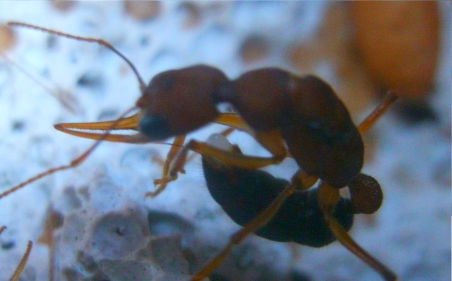
On this picture you can see a worker only some seconds out of the pupae trying to dominate a much older worker, probably out of mistake and not because of hierarchy fights.

About the comparing of Harpegnathos saltator and Harpegnathos venator;
It is very likley that they share many important things like gamergates and the nest structure.
However the body of Harpegnathos venator is much more chunky. They don´t jump as much as Harpegnathos saltator (saltare = latin for jump) and can´t attack their prey from jumping at it as Harpegnathos saltator can.
Harpegnathos venator moves slowly to their prey and then just grabs it with their even stronger mandibles. They also often snap their mandibles several times when attacking prey reminding somewhat Odontomachus.
Their hunting is much slower and their movement is so, too.
Despite the hunting strategy (by the way Harpegnathos venator means translated "the hunting Harpegnathos") and some things in the bodysturcture the ants are much alike and I think that experiances made with one ant can be used as help with the other ant.
One thing Harpegnathos saltator and Harpegnathos venator seem to have in common is that the queens don´t show any aggression against ants of the same species and it seems that nests can even be put together without any problem.
They probably can´t tell sister from stranger apart it seems since they mostly relay on their eyesight and not on chemical ways of communication and orientation.
So when you have two colonies of one of those species you can put them together it seems frome some threads around the internet even with their queens. But since nobody kept Harpegnathos venator a long time till now it is highly questionable if the queens will tolerate each other a long time.
The total of about 7 species of Harpegnathos (and another two subspecies each of Harpeganthos venator and Harpegnathos saltator) are only poorly described exept Harpegnathos saltator.
Of some of those species there aren´t even workers found yet and the most just lack any information about behaviour and everything else. So the information we have about the genus are very few and those we have are also very questionable.
There is much work to be done with this genus...


 , Regarding the last bit adding colonies together , this is somthing i have wondered , i too have come across online several people who have added colonies together and the queens got on fine , This is somthing i shall try to do i think soon , it would be great for the colony if it can be done.


